
1.Introduction
In the production of rubber-insulated wires and cables, the rubber extrusion and vulcanization processes carried out by an Extruder Machine are critical stages that determine the final product quality. During these stages, rubber materials are processed through an Extruder Machine to form the insulation or sheath layer, and then vulcanized under controlled temperature and pressure conditions to achieve the required mechanical, electrical, and aging properties.
However, during actual manufacturing, various quality defects may occur during the operation of the Extruder Machine due to factors such as raw material quality, equipment condition, processing parameters, or operational mistakes. If these problems are not identified and corrected in time, they may negatively affect the appearance, electrical performance, mechanical strength, and long-term reliability of the cable.
Therefore, understanding the common defects that occur during rubber extrusion and vulcanization, analyzing their causes, and implementing effective troubleshooting methods are essential for ensuring stable production and consistent product quality. The following sections summarize several common quality problems encountered in the extrusion and vulcanization process, along with their possible causes and corresponding solutions.
2.Surface Blooming
2.1 Surface blooming refers to a phenomenon where a white powdery substance appears on the surface of the rubber insulation after vulcanization.
2.2 This defect not only affects the appearance of the product but may also indicate incomplete vulcanization.
2.3 Causes
2.3.1 The main cause of surface blooming is insufficient vulcanization.
2.3.2 When the rubber compound is not fully cured, certain ingredients may migrate to the surface, forming a visible layer.
2.4 Solutions
2.4.1 Reduce the line speed to allow sufficient vulcanization time.
2.4.2 Increase the steam pressure in the vulcanization system to improve curing efficiency.
2.4.3 By ensuring proper vulcanization conditions, the blooming phenomenon can be effectively prevented.
3.Surface Impurities or Pre-Cured Rubber Particles
3.1 Another common issue is the presence of impurities or hardened rubber particles on the surface of the extruded insulation.
3.2 These particles may appear as small lumps or irregular spots.
3.3 Causes
3.3.1 The supplied rubber compound is contaminated or contains foreign materials.
3.3.2 The scorch time of the rubber compound is too short.
3.3.3 Excessive temperature in the extruder barrel, head, or die causes premature vulcanization.
3.3.4 Poor rubber flow inside the extrusion head creates stagnation zones where rubber accumulates and cures prematurely.
3.3.5 The screw end is rough or sticky, and the clearance between the screw and barrel is too large, allowing rubber to accumulate in dead zones.
3.3.6 Improper design or selection of the die and mandrel cone angles.
3.4 Solutions
3.4.1 Replace the rubber compound with clean and high-quality material.
3.4.2 Improve the rubber formulation and appropriately extend the scorch time.
3.4.3 Reduce the temperature of the extruder barrel, head, and die.
3.4.4 Optimize the structure of the extrusion head to remove dead corners and ensure smooth rubber flow paths.
3.4.5 Polish the screw end and repair the screw or barrel lining to ensure the proper clearance.
3.4.6 Select suitable dies and mandrels so that the external cone angle of the mandrel is at least 5°smaller than the internal cone angle of the die.
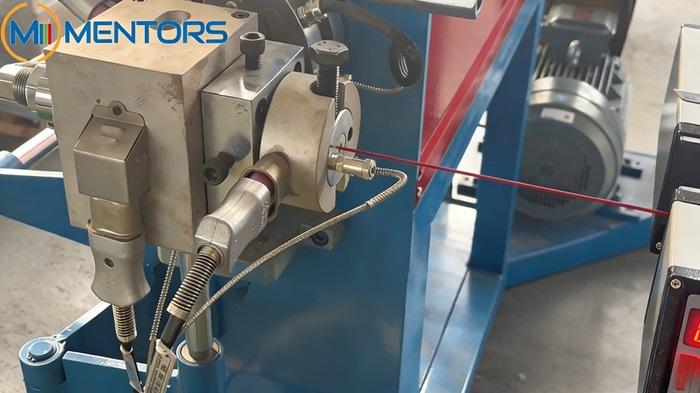
4. Intermittent Copper Exposure or Hard Rubber Blocks
4.1 In some cases, intermittent copper exposure or hardened rubber blocks may appear on the surface of the insulated wire.
4.2 Causes
4.2.1 Rubber compound scorch.
4.2.2 Excessively high extrusion head temperature causing premature vulcanization.
4.3 Solutions
4.3.1 Inspect the rubber compound to determine whether scorch has occurred.
4.3.2 Reduce the extrusion head temperature appropriately.
4.3.3 Maintaining proper temperature control is critical to preventing early curing of rubber materials.
5.Poor Printing or Ink Splashing
5.1 Cable identification marks are usually printed after the insulation layer is formed by the Extruder Machine.
5.2 Poor printing quality or ink splashing can reduce product readability and appearance.
5.3 Causes
5.3.1 Damaged printing wheel.
5.3.2 Worn scraper blade
5.3.3 Improper ink viscosity or concentration.
5.4 Solutions
5.4.1 Replace the damaged printing wheel.
5.4.2 Replace the worn scraper blade.
5.4.3 Adjust the ink concentration to the appropriate level.
5.4.4 Regular maintenance of printing equipment is important for consistent marking quality.
6.Mechanical, Physical, and Aging Performance Not Meeting Requirements
6.1 The rubber insulation must meet strict requirements for mechanical strength, flexibility, and aging resistance.
6.2 If these properties do not meet standards, it may indicate problems in vulcanization or rubber formulation.
6.3 Causes
6.3.1 Insufficient vulcanization results in poor mechanical and physical properties.
6.3.2 Over-vulcanization can reduce aging resistance.
6.3.3 Errors in rubber formulation or mixing process.
6.4 Solutions
6.4.1 If the rubber is under-vulcanized, increase steam pressure or reduce the traction speed.
6.4.2 If the rubber is over-vulcanized, take the opposite measures by reducing curing intensity.
6.4.3 Adjust the vulcanization system in the rubber formulation to extend the optimum curing time and produce a flatter curing curve.
6.4.4 Recheck the rubber formulation to ensure additives such as antioxidants, curing agents, and accelerators were correctly added during mixing.
6.4.5 Proper control of both formulation and curing conditions is essential to achieving the desired performance.
7.Excessive Spark Test Failures or Poor Insulation Resistance
7.1 During production, insulation layers are usually tested with a spark tester to detect defects.
7.2 Excessive spark failures or low insulation resistance indicates insulation quality problems.
7.3 Causes
7.3.1 Insufficient vulcanization leading to flattened insulation.
7.3.2 Impurities, bubbles, or cracks in the rubber.
7.3.3 Scratches or damage on the insulation surface.
7.3.4 Eccentric insulation or insufficient insulation thickness.
7.3.5 Test voltage set too high.
7.4 Solutions
7.4.1 Increase steam pressure or reduce traction speed to improve vulcanization.
7.4.2 Strengthen rubber filtration and maintain cleanliness during transportation, warming, and feeding processes.
7.4.3 Properly control the tension of the insulated core and ensure orderly cable arrangement to prevent deformation.
7.4.4 Adjust eccentricity and increase insulation thickness if necessary.
7.4.5 Conduct voltage testing according to the specified process standards.
7.4.6 Maintaining material cleanliness and correct process control is key to ensuring insulation reliability.
8.Rough Surface or Scratches
8.1 A smooth surface is essential for both aesthetics and performance.
8.2 Rough surfaces or scratches may occur if the extrusion conditions are not properly controlled.
8.3 Causes
8.3.1 Improper die length or oversized die opening.
8.3.2 Low plasticity of the rubber compound.
8.3.3 Low temperature at the extruder barrel, head, or die.
8.3.4 Impurities or scorched rubber blocking the die opening.
8.3.5 Rough mold surfaces.
8.4 Solutions
8.4.1 Replace the die with a suitable one.
8.4.2 Improve rubber plasticity by increasing warming temperature and time, or by adding an appropriate amount of plasticizer.
8.4.3 Increase the temperature of the extruder barrel, head, and die appropriately.
8.4.4 Disassemble the extrusion head and remove impurities or scorched rubber from the die and mandrel.
8.4.5 Replace damaged molds.
9.Uneven Outer Diameter or Bamboo-Shaped Appearance
9.1 Sometimes the extruded insulation may show periodic thick and thin sections, often described as a bamboo-shaped appearance.
9.2 Causes
9.2.1 Unstable traction speed.
9.2.2 Uneven feeding of rubber material.
9.2.3 Improper die or mandrel size.
9.2.4 Uneven pay-off tension.
9.2.5 Non-uniform rubber plasticity.
9.3 Solutions
9.3.1 Repair or adjust equipment to ensure stable traction speed.
9.3.2 Ensure consistent feeding of rubber material.
9.3.3 Replace the die or mandrel with suitable sizes.
9.3.4 Adjust tension wheels to maintain uniform pay-off tension.
9.3.5 Replace the rubber compound if its plasticity is inconsistent.
10.Eccentric Insulation
10.1 Eccentric insulation occurs when the insulation thickness is uneven around the conductor.
10.2 Causes
10.2.1 Incorrect alignment between the die and mandrel.
10.2.2 Oversized mandrel hole or insufficient bearing length.
10.2.3 Damaged molds.
10.2.4 Impurities between the die and mandrel.
10.2.5 Unstable pay-off tension.
10.2.6 Irregular or snake-shaped conductor.
10.3 Solutions
10.3.1 Readjust the alignment of the die and mandrel.
10.3.2 Replace the mandrel or tighten it securely.
10.3.3 Replace damaged molds.
10.3.4 Remove impurities and hardened rubber from the die.
10.3.5 Increase pay-off tension to improve stability.
10.3.6 Ensure the conductor and cable core are round and straight.
11.Micropores in the Rubber Cross-Section
11.1 Micropores may appear in the cross-section of rubber insulation, affecting its mechanical strength and electrical properties.
11.2 Causes
11.2.1 Low steam pressure during vulcanization.
11.2.2 Insufficient rubber density.
11.2.3 Rapid pressure release during vulcanization when the line stops.
11.3 Solutions
11.3.1 Increase steam pressure appropriately and adjust traction speed while maintaining proper vulcanization.
11.3.2 Increase extrusion pressure by selecting longer dies, screws with higher compression ratios, and larger cone-angle differences between die and mandrel.
11.3.3 Ensure sufficient vulcanization time and release steam pressure slowly.
12.Conclusion
The Extruder Machine plays a vital role in the rubber extrusion and vulcanization process for wire and cable manufacturing. During production, various defects such as surface blooming, impurities, eccentric insulation, rough surfaces, and uneven diameters may occur.
By analyzing the root causes of these problems and implementing proper process control, equipment maintenance, and raw material management, manufacturers can significantly reduce defects and ensure stable operation of the Extruder Machine production line.
Continuous optimization of the Extruder Machine extrusion process and strict quality control are essential for producing high-quality rubber-insulated cables that meet industry standards and customer requirements.
Click here to see the running video of Extruder Machine
NOTE:All rights reserved, Reprinting is prohibited without permission.