
1.Introduction
In the wire and cable manufacturing industry, conductor stranding is a critical process that directly affects electrical performance, mechanical strength, and long-term reliability of finished cables. Among various stranding solutions, the Rigid Frame Stranding Machine is widely recognized as the most reliable and stable equipment for medium to large cross-section conductors.
However, not all rigid frame stranders are the same. One of the most important decisions cable manufacturers face is frame size selection, especially when choosing between commonly used configurations such as the 500 and 630 Rigid Frame Stranding Machine.
While both machines share the same fundamental working principle, they differ significantly in terms of capacity, application range, production efficiency, investment cost, and operational flexibility. Understanding these differences is essential for selecting the right equipment that aligns with production strategy, market positioning, and long-term business goals.
This article provides a detailed comparison between the 500 and 630 Rigid Frame Stranding Machine, helping manufacturers make informed decisions based on technical requirements and production realities.
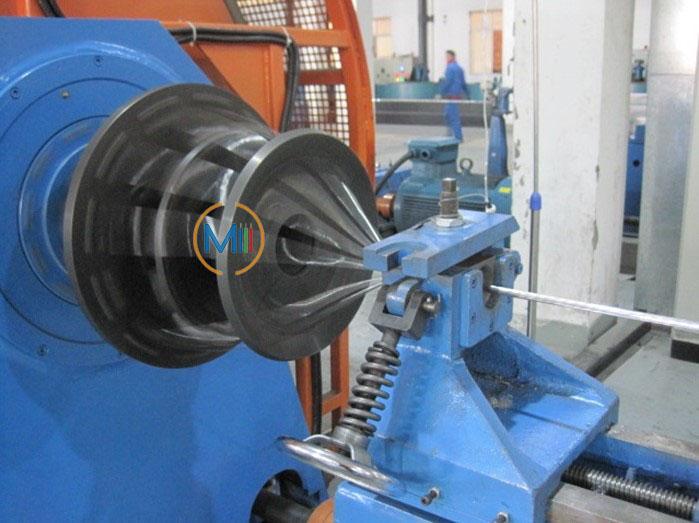
2.Rigid Frame Stranding Machine: Flexible Solution for Small to Medium Production
2.1 Core Structural Parameters
2.1.1 The 500 Frame Rigid Frame Strander is built around a center bobbin diameter of 500 mm, which defines its wire capacity and overall machine scale.
2.1.2 Typical wire range includes:
(1) Copper wire: Φ1.5 – Φ4.6 mm
(2) Aluminum wire: Φ1.8 – Φ5.0 mm
(3) Bobbin size inside of cage: 500
2.1.3 These parameters make the 500 Frame suitable for a wide range of small to medium conductor sizes commonly used in low- and medium-voltage power cables.
2.2 Production Characteristics
2.2.1 The 500 Frame strander is designed with flexibility as a core advantage.
2.2.2 Its relatively compact size allows faster response to product changes, making it ideal for factories that produce diversified conductor types in smaller or medium batches.
2.2.3 Due to the smaller pay-off bobbins, the machine typically requires more frequent reel changes.
2.2.4 While this limits uninterrupted production time, it also enables quicker setup and changeover, which is beneficial when handling multiple product specifications.
2.3 Advantages of the 500 Frame
2.3.1 One of the most significant advantages of the 500 Frame rigid strander is its compact footprint.
2.3.2 The smaller machine size reduces floor space requirements, making it suitable for factories with limited workshop space or for production lines that need to be arranged flexibly.
2.3.3 Operationally, the 500 Frame offers:
(1) Faster model changeover
(2) Easier setup and adjustment
(3) Lower initial investment cost
(4) Reduced foundation and installation requirements
2.3.4 These advantages make it a cost-effective solution for manufacturers focusing on small to medium batch production, pilot projects, or diversified product portfolios.
2.4 Limitations of the 500 Frame
2.4.1 Despite its flexibility, the 500 Frame has inherent limitations.
2.4.2 The smaller bobbin capacity restricts its ability to handle very large cross-section conductors or products with a high number of strands.
2.4.3 In addition, frequent reel changes may reduce overall efficiency when producing large quantities of standardized products.
2.4.4 For manufacturers targeting mass production of large conductors, the 500 Frame may not be the optimal long-term solution.
3.630 Frame Rigid Frame Strander: High-Capacity Solution for Large-Scale Production
3.1 Core Structural Parameters
3.1.1 Typical wire range includes:
(1) Copper wire: Φ1.8 – Φ4.6 mm
(2) Aluminum wire: Φ2.0 – Φ5.0 mm
(3) Bobbin size inside of cage: 630
3.1.2 The 630 Frame excels in handling larger conductor cross-sections and higher strand counts.
3.2 Production Characteristics
3.2.1 The defining feature of the 630 Frame strander is its strong stranding capability.
3.2.2 Larger pay-off bobbins allow longer continuous operation, reducing downtime caused by reel changes and significantly improving production efficiency.
3.2.3 This machine is especially suitable for standardized products produced in large volumes, such as medium- and high-voltage power cable conductors or overhead transmission conductors.
3.3 Advantages of the 630 Frame
3.3.1 The 630 Frame rigid strander is optimized for high-efficiency, large-scale production. Its key advantages include:
(1) Ability to process large cross-section and multi-core conductors
(2) Larger bobbin capacity enabling longer uninterrupted production
(3) Higher overall production efficiency
(4) Stable performance during long-term continuous operation
3.3.2 For manufacturers focused on supplying utility projects, infrastructure developments, or export markets requiring high output and consistency, the 630 Frame provides a strong competitive advantage.
3.4 Limitations of the 630 Frame
3.4.1 The increased capacity of the 630 Frame comes with trade-offs.
3.4.2 The machine has a larger footprint, requiring more workshop space and a stronger foundation.
3.4.3 Initial investment costs are also higher compared to the 500 Frame.
3.4.4 Additionally, due to its larger scale and more complex setup, product changeover and adjustment typically take more time.
3.4.5 As a result, the 630 Frame is less suitable for frequent specification changes or small-batch production.
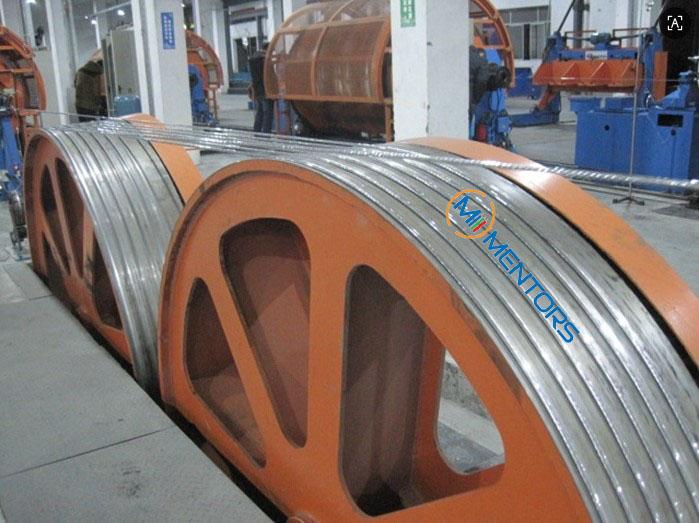
4.Direct Comparison: 500 and 630 Rigid Frame Stranding Machine
| Dimension | 500 Frame Strander | 630 Frame Strander |
| Production Capacity | Designed for flexibility and moderate output | Designed for high-capacity, continuous production |
| Product Range | Supports broader variety of small and medium conductors | Excels in large cross-section and multi-core conductor production |
| Efficiency | Frequent reel changes limit efficiency in mass production | Larger bobbins reduce downtime, improve overall line efficiency |
| Investment & Operating Cost | Lower initial investment, simpler infrastructure | Higher upfront cost, lower unit production cost in high-volume manufacturing |
| Factory Conditions | Favored in limited space, diversified production | Favored in large workshops, standardized production lines |
5.Selection Guidelines: Which Frame Is Right for You?
5.1 Choosing between a 500 Frame and a 630 Frame rigid strander should be based on a clear understanding of production strategy rather than purely technical specifications.
5.2 The 500 Frame is recommended if:
5.2.1 Production involves multiple conductor types
5.2.2 Batch sizes are small to medium
5.2.3 Factory space is limited
5.2.4 Investment budget is constrained
5.2.5 Fast changeover is a priority
5.3 The 630 Frame is recommended if:
5.3.1 Production focuses on large cross-section conductors
5.3.2 Batch sizes are large and standardized
5.3.3 High efficiency and long continuous operation are required
5.3.4 Factory layout allows larger equipment
5.3.5 Long-term unit cost reduction is a key objective
6.Long-Term Production Strategy Considerations
6.1 Beyond immediate production needs, manufacturers should also consider long-term strategy.
6.2 Market demand may evolve toward higher-capacity power cables, especially with the growth of renewable energy, grid expansion, and infrastructure investment.
6.3 In such cases, selecting a 630 Frame strander may provide better scalability and future-proofing.
6.4 Conversely, manufacturers serving diverse niche markets may benefit more from the flexibility offered by the 500 Frame.
7.Conclusion
Both the 500 and 630 Rigid Frame Stranding Machines are proven solutions within the rigid frame stranding category. They are not competitors but complementary tools designed for different production philosophies.
The 500 Rigid Frame Stranding Machine emphasizes flexibility, lower investment, and adaptability, making it ideal for diversified and small to medium batch production. The 630 Rigid Frame Stranding Machine focuses on capacity, efficiency, and stability, supporting large-scale and standardized manufacturing.
By carefully evaluating production requirements, factory conditions, and long-term business goals, manufacturers can select the frame size that delivers the greatest value and supports sustainable growth in an increasingly competitive cable market.
Click here to see the running video of Rigid Frame Stranding Machine
NOTE:All rights reserved, Reprinting is prohibited without permission.