
Electrolytic tin plating machine has become an indispensable part of modern manufacturing, especially in industries where electrical performance, corrosion resistance, and long-term reliability are critical. From consumer electronics and data transmission cables to automotive components and precision parts, tinned copper wires ensure stable conductivity and enhanced protection even under harsh conditions. As market demands continue to grow, manufacturers are seeking more sophisticated continuous plating systems that promise consistent coating quality, energy efficiency, and operational stability.
This article provides an in-depth overview of the electrolytic tin plating process, while integrating key technical details drawn from real production line configurations. It highlights not only how electrolytic tin plating works, but also how proper preparation, precise process control, and high-quality equipment together determine the final performance of tinned copper wire.
1.Overview of the Electrolytic Tin Plating Machine
1.1 A modern continuous Electrolytic Tin Plating Machine production line is designed to handle various specifications of copper wires listed in its technical data.
1.2 In most wire-processing factories, tin plating is performed through the electrolysis of a specially formulated solution.
1.3 During the process, the copper wire—after drawing or pre-electroplating treatment—passes through a controlled electrochemical environment where a fine, dense, and uniform tin coating is deposited on its surface.
1.4 Tin Source and Electrochemical Principle: The tin required for deposition is placed in the electroplating tank in the form of tin plates or tin blocks, positioned inside titanium anode baskets.
1.5 Under high current density, tin ions dissolve into the plating solution and migrate toward the cathode (the moving copper wire), forming a continuous metallic coating.
1.6 The plating solution typically adopts a methylsulfonic acid-based (MSA) electrolyte, well-known for its high solubility, stable acidity, and ability to deliver excellent coating compactness.
1.7 A small dosage of additives is carefully introduced to enhance brightness, improve deposit density, stabilize crystal structure, and accelerate the plating rate.
1.8 To achieve stable output quality, precise pretreatment and post-treatment steps are required.
1.9 These stages collectively eliminate oil residue, oxidation layers, and surface contaminants while ensuring optimal adhesion and uniformity of the plated tin layer.
2.Complete Process Flow of the Tin Plating Line
2.1 Technological process
Coiler Pay-off → Electrolytic Cathodic Degreasing → Water Washing → Pickling (Acid Electrolysis) → Water Washing → Electrolytic Tin Plating → Recovery → Hot Water Washing → Hot Water Drying → Coiler Take-up → Electrolytic Film Thickness Measurement
2.2 Detailed Description of Each Stage
2.2.1 Wire Pay-off and Entry
(1) Copper wire is fed from the customer’s pay-off bobbin and guided into the production line through a cage-type payoff system.
(2) Before entering the plating unit, the wire may pass through auxiliary devices (e.g., wire-breaking units) to ensure alignment and stable tension.
2.2.2 Electrolytic Degreasing
(1) During wire drawing, lubricants and microscopic metal particles adhere to the copper surface.
(2) Electrolytic degreasing removes these contaminants using a specialized imported electrolyte heated to 55–65℃.
(3) The heating mechanism is electrically controlled, supported by built-in temperature control devices to ensure consistent operating conditions.
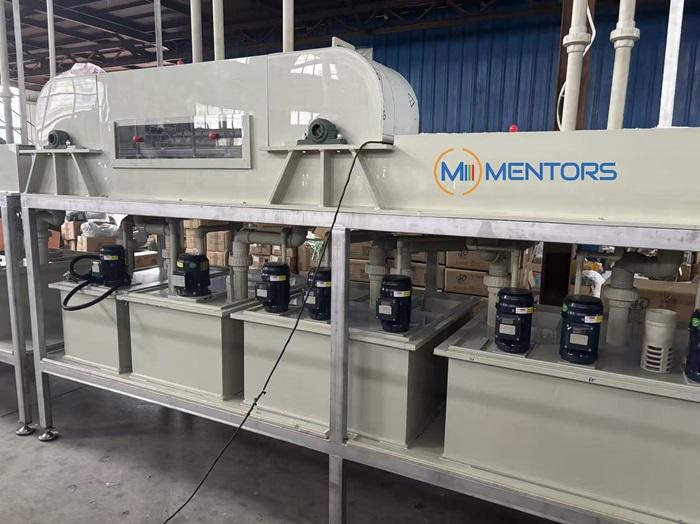
(4) The degreasing station includes: a main tank storing the electrolyte, a working sub-tank designed as an overflow tank, a circulation pump that continuously transfers the solution between tanks
(5) This circulation ensures stable electrolyte concentration and flow dynamics, which directly affects cleaning performance.
(6) After degreasing, the wire is washed through a three-stage countercurrent water rinse, effectively removing residual chemicals.
2.2.3 Acid Electrolytic Activation (Pickling)
(1) The purpose of this step is twofold: Remove rust, oxide layers, and minor impurities, neutralize and prepare the wire surface for the tin plating bath
(2) The sub-tank and the main pickling tank are connected through a pump-driven circulation system to maintain uniform solution activity.
(3) A second water rinsing stage removes traces of acid to prevent contamination of the subsequent plating bath.
2.2.4 Electrolytic Tin Plating
(1) This is the core process of the production line.
(2) The tin plating solution is maintained at 45–55°C
(3) The tin anode plates are placed inside titanium baskets
(4) Current is passed through the copper ring to dissolve the tin anodes
(5) Additives are replenished according to ampere-hour calculations
(6) Tin blocks are added periodically to maintain tin concentration
(7) Plating solution circulation mimics the degreasing system to preserve stability
(8) Thanks to continuous replenishment, temperature regulation, and precise current control, the wire receives a compact and uniform tin layer with excellent conductivity and solderability.
(9) After tin plating, the wire again passes through a three-stage countercurrent rinse, ensuring the surface is completely clean and free from chemical residues.
2.2.5 Hot Water Washing & Drying
Finally, the wire undergoes hot water washing and hot air drying to ensure that the plated surface remains spotless and corrosion-free prior to take-up.
3.Factory Preparation and Commissioning
To ensure optimal performance of a newly installed line, several preparation steps must be completed.
3.1 Debugging and Functional Checks
3.1.1 Before commissioning: water tank sealing test, water pipe pressure test, pump rotation direction check, verification of auto/manual modes, testing of safety devices.
3.1.2 During maintenance, all service switches must remain OFF to ensure safety.
3.2 Initial Commissioning: All control settings—speed parameters, temperature set points, valve configurations—must be fully documented and included in the machine’s operation manual.
3.3 Degreasing Solution Maintenance
3.3.1 Daily and weekly maintenance includes: monitoring evaporation and replenishing water, weekly bath analysis, complete solution replacement every 8–12 weeks, followed by tank flushing.
3.3.2 Maintaining proper degreasing chemistry is one of the most crucial factors affecting plating quality.
3.4 Tin Plating Solution Maintenance
3.4.1 Daily monitoring of evaporation losses
3.4.2 Daily analysis of plating solution during initial operation
3.4.3 Adjusting additive and tin concentration based on laboratory results
3.4.4 Strict adherence to the chemical supplier’s safety guidelines
3.4.5 Ensuring the electrolyte remains in its optimal state guarantees uniform plating thickness and stable electrical performance.
1.Overview of the Electrolytic Tin Plating Machine
1.1 A modern continuous Electrolytic Tin Plating Machine production line is designed to handle various specifications of copper wires listed in its technical data.
1.2 In most wire-processing factories, tin plating is performed through the electrolysis of a specially formulated solution.
1.3 During the process, the copper wire—after drawing or pre-electroplating treatment—passes through a controlled electrochemical environment where a fine, dense, and uniform tin coating is deposited on its surface.
1.4 Tin Source and Electrochemical Principle: The tin required for deposition is placed in the electroplating tank in the form of tin plates or tin blocks, positioned inside titanium anode baskets.
1.5 Under high current density, tin ions dissolve into the plating solution and migrate toward the cathode (the moving copper wire), forming a continuous metallic coating.
1.6 The plating solution typically adopts a methylsulfonic acid-based (MSA) electrolyte, well-known for its high solubility, stable acidity, and ability to deliver excellent coating compactness.
1.7 A small dosage of additives is carefully introduced to enhance brightness, improve deposit density, stabilize crystal structure, and accelerate the plating rate.
1.8 To achieve stable output quality, precise pretreatment and post-treatment steps are required.
1.9 These stages collectively eliminate oil residue, oxidation layers, and surface contaminants while ensuring optimal adhesion and uniformity of the plated tin layer.
2.Complete Process Flow of the Tin Plating Line
2.1 Technological process
Coiler Pay-off → Electrolytic Cathodic Degreasing → Water Washing → Pickling (Acid Electrolysis) → Water Washing → Electrolytic Tin Plating → Recovery → Hot Water Washing → Hot Water Drying → Coiler Take-up → Electrolytic Film Thickness Measurement
2.2 Detailed Description of Each Stage
2.2.1 Wire Pay-off and Entry
(1) Copper wire is fed from the customer’s pay-off bobbin and guided into the production line through a cage-type payoff system.
(2) Before entering the plating unit, the wire may pass through auxiliary devices (e.g., wire-breaking units) to ensure alignment and stable tension.
2.2.2 Electrolytic Degreasing
(1) During wire drawing, lubricants and microscopic metal particles adhere to the copper surface.
(2) Electrolytic degreasing removes these contaminants using a specialized imported electrolyte heated to 55–65℃.
(3) The heating mechanism is electrically controlled, supported by built-in temperature control devices to ensure consistent operating conditions.
(4) The degreasing station includes: a main tank storing the electrolyte, a working sub-tank designed as an overflow tank, a circulation pump that continuously transfers the solution between tanks
(5) This circulation ensures stable electrolyte concentration and flow dynamics, which directly affects cleaning performance.
(6) After degreasing, the wire is washed through a three-stage countercurrent water rinse, effectively removing residual chemicals.
2.2.3 Acid Electrolytic Activation (Pickling)
(1) The purpose of this step is twofold: Remove rust, oxide layers, and minor impurities, neutralize and prepare the wire surface for the tin plating bath
(2) The sub-tank and the main pickling tank are connected through a pump-driven circulation system to maintain uniform solution activity.
(3) A second water rinsing stage removes traces of acid to prevent contamination of the subsequent plating bath.
2.2.4 Electrolytic Tin Plating
(1) This is the core process of the production line.
(2) The tin plating solution is maintained at 45–55°C
(3) The tin anode plates are placed inside titanium baskets
(4) Current is passed through the copper ring to dissolve the tin anodes
(5) Additives are replenished according to ampere-hour calculations
(6) Tin blocks are added periodically to maintain tin concentration
(7) Plating solution circulation mimics the degreasing system to preserve stability
(8) Thanks to continuous replenishment, temperature regulation, and precise current control, the wire receives a compact and uniform tin layer with excellent conductivity and solderability.
(9) After tin plating, the wire again passes through a three-stage countercurrent rinse, ensuring the surface is completely clean and free from chemical residues.
2.2.5 Hot Water Washing & Drying
Finally, the wire undergoes hot water washing and hot air drying to ensure that the plated surface remains spotless and corrosion-free prior to take-up.
3.Factory Preparation and Commissioning
To ensure optimal performance of a newly installed line, several preparation steps must be completed.
3.1 Debugging and Functional Checks
3.1.1 Before commissioning: water tank sealing test, water pipe pressure test, pump rotation direction check, verification of auto/manual modes, testing of safety devices.
3.1.2 During maintenance, all service switches must remain OFF to ensure safety.
3.2 Initial Commissioning: All control settings—speed parameters, temperature set points, valve configurations—must be fully documented and included in the machine’s operation manual.
3.3 Degreasing Solution Maintenance
3.3.1 Daily and weekly maintenance includes: monitoring evaporation and replenishing water, weekly bath analysis, complete solution replacement every 8–12 weeks, followed by tank flushing.
3.3.2 Maintaining proper degreasing chemistry is one of the most crucial factors affecting plating quality.
3.4 Tin Plating Solution Maintenance
3.4.1 Daily monitoring of evaporation losses
3.4.2 Daily analysis of plating solution during initial operation
3.4.3 Adjusting additive and tin concentration based on laboratory results
3.4.4 Strict adherence to the chemical supplier’s safety guidelines
3.4.5 Ensuring the electrolyte remains in its optimal state guarantees uniform plating thickness and stable electrical performance.
4.Wire Threading and Operation Preparation
4.1 Before wire threading, operators must select the “threading mode” on the control panel, typically setting the running speed at 10 m/min for safety and stability.
4.2 Operators manually guide the wire:
4.2.1 Through the payoff machine
4.2.2 Into auxiliary devices
4.2.3 Then into the degreasing tank
4.3 To avoid copper slag formation, the entire line is operated at low speed for several minutes under the “No Plating” mode.
4.4 Once the wire runs smoothly with no slag on the conductive rod, gates in degreasing and plating tanks are carefully adjusted to avoid interference with the moving wire.
4.5 Anode tin plates are inserted into the titanium basket, pumps are turned on, and operators ensure each tank contains sufficient solution to fully immerse the wire.
4.6 After preparations, heating and circulation begin, enabling the system to reach stable working conditions.
5.Conclusion
Electrolytic Tin Plating Machine remains one of the most essential processes in modern wire manufacturing, delivering superior corrosion resistance, stable conductivity, and excellent solderability. By integrating precise pretreatment, advanced plating chemistry, automated circulation systems, and strict maintenance protocols, today’s continuous electroplating lines achieve exceptional production reliability and coating consistency.
With growing global demand for high-performance tinned copper wires used in electronics, telecommunications, automotive systems, and renewable energy applications, manufacturers equipped with state-of-the-art tin plating technology gain a significant competitive edge. Combining innovation, process control, and quality assurance, electrolytic tin plating will continue to play a vital role in shaping the future of high-precision manufacturing.
Click here to see the running video of Electrolytic Tin Plating Machine
NOTE:All rights reserved, Reprinting is prohibited without permission.