
1.Introduction
In the wire and cable manufacturing industry, wire drawing and annealing are two essential processes for producing high-quality conductors. During wire drawing, copper or other metal wire is continuously reduced in diameter through a series of drawing dies. According to the production method, Annealing Machine used in the wire and cable industry can generally be divided into Continuous Annealing Machine and Non-continuous Annealing Machine. Continuous annealing has become the preferred solution for modern high-efficiency wire production, while non-continuous equipment is mainly used in specific production applications.
2.Non-Continuous Annealing Machine
2.1 Although the industry has largely shifted toward continuous technologies, batch-type furnaces are still employed in certain scenarios, particularly for heavy-gauge rods, specialty alloys, or facilities with low production volumes.
2.2 These systems separate the drawing and annealing operations into distinct production stages, requiring intermediate material handling, storage, and scheduling.
2.3 Key types and characteristics of Non-Continuous Annealing Machine
| Equipment Type | Core Structure & Workflow | Key Features |
| Pot-type annealing furnace | Pit-type circular resistance furnace, paired with steel pots. Wire coils are loaded into pots, heated in the furnace, then moved out for external cooling. | Traditional batch unit; low automation; single-batch production; prone to non-uniform inner/outer layer quality. |
| Bell-type annealing furnace | Wire coils on a trolley are placed under a bell-shaped resistance cover; heating is performed under vacuum or protective atmosphere; after cooling, the bell is lifted and the trolley moves out. | Intermittent batch production; requires vacuum environment; lower efficiency than continuous equipment. |
| Copper tube-type annealing furnace | Wire continuously passes through an electrically heated furnace tube, absorbing radiant heat; water seals and positive internal pressure prevent oxidation. | Comprises pay-off stand, heated tube, inlet/outlet water seals, drying blower, and take-up unit; semi-continuous in material movement. |
| Ferrous metal tube-type annealing furnace | Similar tube design but with higher temperatures and strong reducing/inert gases to prevent oxidation and decarburization of steel/stainless steel wire. | Multi-zone heating system; relies on protective atmosphere; used for stress-relief or softening of black metals. |
3.Continuous Annealing Machine
3.1 Working Principle of Continuous Machine
3.1.1 The fundamental principle is elegantly simple yet highly effective: the drawn wire itself acts as the heating element.
3.1.2 As the wire passes between two or more electrically conductive contact sheaves (wheels), a high-current, low-voltage electric current is passed directly through the moving wire.
3.1.3 The wire’s own electrical resistance generates Joule heat, raising its temperature to the recrystallization range within a fraction of a second.
3.1.4 This self-heating mechanism is remarkably efficient because virtually all electrical energy is converted into heat within the workpiece, with minimal losses to the surroundings.
3.2 Advantages of Resistance Continuous Annealing
3.2.1 Exceptional property uniformity
(1) The extremely short heating time (typically 0.05–0.3 seconds) ensures that the entire cross-section of the wire reaches the desired temperature almost instantaneously, eliminating the severe temperature gradients inherent in batch coils.
(2) The resulting elongation and conductivity values are consistently superior and tightly controlled.
3.2.2 Significant Energy Savings
(1) By directly heating the wire without intermediary furnace walls, refractories, or massive steel pots, these systems reduce electrical consumption by 30% to 50% compared to batch furnaces.
(2) This energy efficiency translates directly into lower operating costs and reduced carbon footprint.
3.2.3 Elimination of Quality Defects
(1) Problems such as interlayer sticking, surface scratching, and non-uniform annealing—common in pot-type furnaces—are virtually eliminated.
(2) The wire exits the annealer with a clean, bright surface and homogeneous grain structure.
3.2.4 Productivity Leap
(1) By combining drawing and annealing into a single, continuous operation, the total production cycle is drastically shortened.
(2) Intermediate storage, transport, and re-handling are completely removed, reducing work-in-progress inventory and factory floor space.
3.2.5 Improved Working Conditions
(1) Operators are freed from the heavy, hot, and dusty tasks of loading/unloading pots, moving trolleys, and manually inspecting coil quality.
(2) The process is fully automatic, with modern systems integrating speed and tension feedback for closed-loop control.
3.3 Three Parameters in Continuous Annealing Machine
3.3.1 Wire Tension
(1) Tension must be carefully balanced. Excessive tension can neck down or even break the wire, reducing its final diameter below specification.
(2) Insufficient tension causes the wire to flutter or vibrate on the contact sheaves, leading to arcing (sparking) that erodes both the wire surface and the sheave contact faces.
3.3.2 Wire Running Stability
(1) The wire must maintain steady, concentric contact with the sheaves without any lateral oscillation.
(2) Even minor vibrations can produce intermittent electrical contacts, resulting in surface discharges that create pits, roughness, and potential weak spots.
3.3.3 Electrical Parameters (Voltage and Current)
(1) Maintaining a constant annealing voltage and current is essential. Fluctuations in either parameter cause variations in heating power, leading to non-uniform elongation along the wire length.
(2) Modern annealers employ thyristor-controlled power supplies with real-time speed tracking to ensure consistent energy input per unit length.
4.Structural Classification of Continuous Annealers
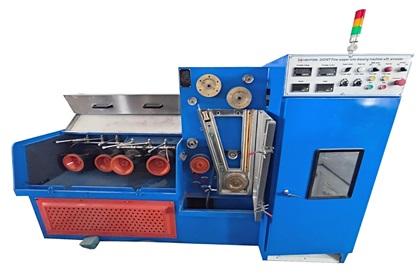
4.1 Small-Sized Continuous Annealers (for fine wires up to ~1.2 mm diameter)
| Door Type | Main Structure And Characteristics | Remarks |
| Triangular-door
|
Door is closed and sealed by a triangular double-link toggle mechanism applying single-point clamping force. | Robust but may distribute pressure unevenly. |
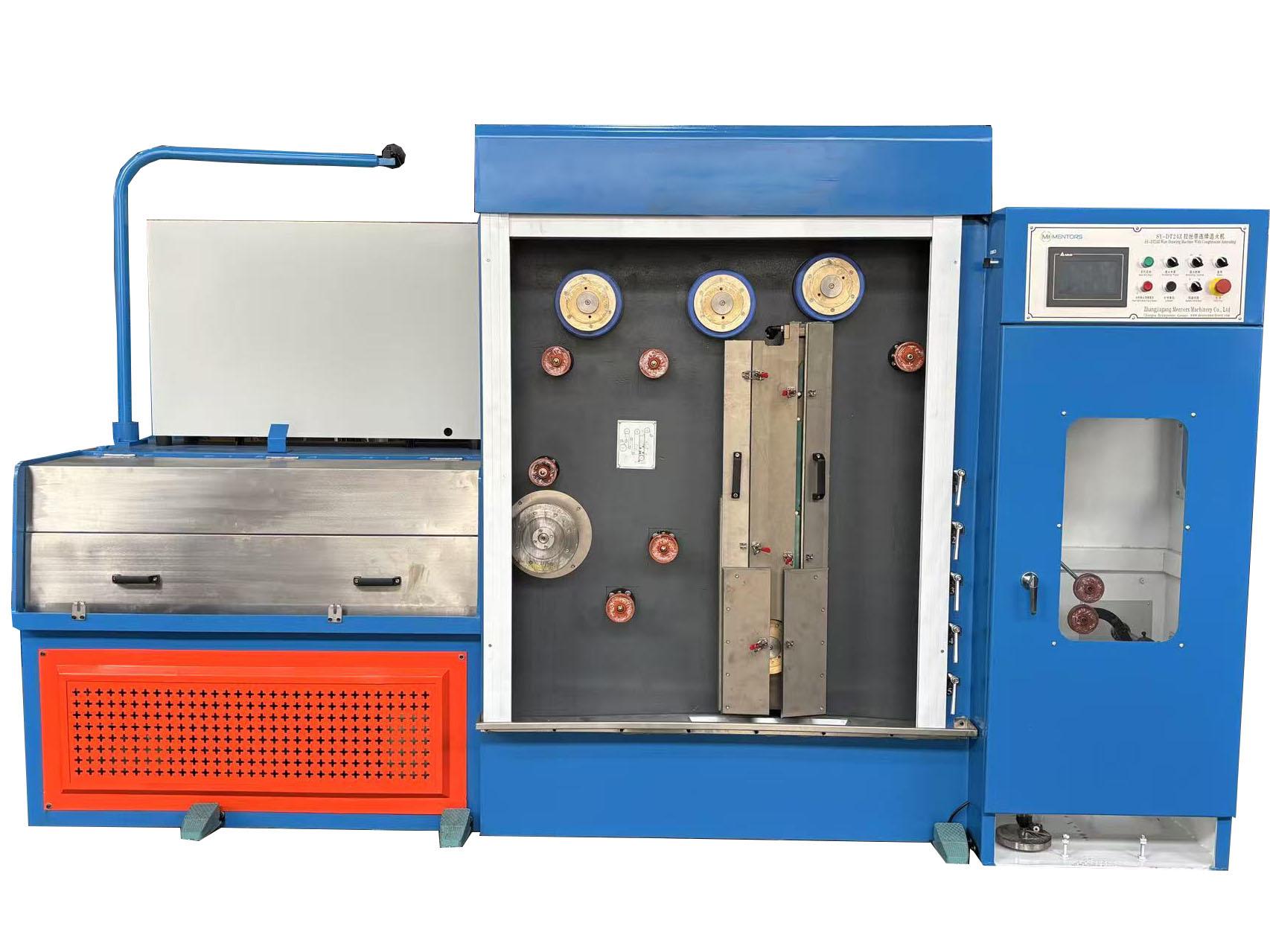
| Square-door
|
Square flanged door with pneumatic cylinders or multiple latches around the perimeter; provides uniform parallel clamping across the entire sealing surface. | More modern design; ensures better atmosphere integrity. |
4.2 Large-Sized Continuous Annealers (for medium to heavy gauges, 1.2–4.5 mm diameter)
| Parameter | Specification |
| Contact sheave diameter | Typically 400–450 mm |
| Power transmission | Heavy-duty brushes to minimize voltage drop; drive synchronized with drawing machine capstan. |
| Configuration options | Standard: two-stage (DC-powered); optional: three-stage (AC-powered) upon request. |
| Power supply | Three single-phase transformers; voltage 25–65 V; power rating 140–220 kVA. |
| Control method | Annealing voltage adjusted dynamically in proportion to drawing speed; closed-loop feedback from speed sensors and tension transducers ensures automatic compensation for line-speed fluctuations. |
5.How to Choose the Right Annealing Machine For Wire Drawing
5.1 The selection of Annealing Machine should be based on several production factors, including wire material, wire diameter, production speed, required mechanical properties and overall production volume.
5.2 For copper wire manufacturers operating high-speed drawing lines, continuous contact-resistance annealing is generally an efficient solution because it integrates drawing and annealing and provides stable electrical and mechanical performance.
5.3 For medium- and large-diameter wires, the equipment configuration should be selected according to the wire diameter and required production speed. Larger contact wheels and appropriate electrical capacity can be selected to meet higher production requirements.
5.4 For special production conditions or applications where batch processing is acceptable, non-continuous annealing furnaces may still provide a practical solution.
6.Conclusion
Annealing is a critical process in wire and cable manufacturing because it restores the flexibility and mechanical properties of work-hardened wire after drawing. With the development of modern manufacturing technology, Continuous Wire Drawing And Annealing has become an important solution for improving production efficiency, reducing energy consumption and achieving consistent product quality.
Continuous contact-resistance annealing heats the moving wire directly through electrical resistance, allowing the annealing process to be integrated with wire drawing. Compared with traditional separate annealing processes, it can reduce intermediate handling, save production space, lower labor requirements and improve overall production efficiency.
At the same time, reliable operation requires careful control of wire tension, wire stability, electrical current and voltage. Proper coordination between the drawing machine, annealing system, cooling system and take-up unit is essential to achieve stable production.
With appropriate equipment configuration and process control, a modern Wire Drawing and Annealing line can provide manufacturers with an efficient, stable and energy-conscious solution for producing high-quality copper and other metal wires.
Click here to see the details of the Wire Drawing Machine With Annealing
NOTE:All rights reserved, Reprinting is prohibited without permission.