
1.Introduction
Wire drawing is one of the most important metal-forming processes in the wire and cable industry. It is used to reduce the diameter of metal rods or wires by pulling them through one or multiple drawing dies. Through plastic deformation, the cross-sectional area of the material is reduced while its length increases. The equipment used to perform this process is known as a wire drawing machine, which serves as a core component in the production of electrical conductors, communication cables, and various industrial wire products.
With the continuous development of the wire and cable industry, different types of wire drawing machines have been developed to meet diverse production requirements regarding material properties, production efficiency, surface quality, and energy consumption.
2.Definition and Classification of Wire Drawing Machine
2.1 Fundamental Principle
2.1.1 Wire drawing is a metalworking process that utilizes the plasticity of metals.
2.1.2 During the process, a wire or rod is pulled through a die with a smaller opening than the original diameter of the material.
2.1.3 As the material passes through the die, its diameter decreases while its length increases.
2.1.4 The machine that performs this operation is called a wire drawing machine.
2.1.5 In modern cable manufacturing plants, wire drawing equipment plays a critical role in preparing conductors for subsequent processes such as annealing, stranding, insulating, and cabling.
2.2 Major Classification Methods
2.2.1 By Number of Dies
(1) Single-Die Wire Drawing Machine
(2) A single-die wire drawing machine performs one drawing operation at a time through a single die.
(3) It is primarily used for drawing large-diameter wire, rods, profiles, and ferrous metal products.
(4) Due to its simple structure and flexible operation, the single-die machine remains widely used in applications requiring large drawing forces and relatively low production speeds.
(5) Multi-Die Continuous Wire Drawing Machines
(6) A multi-die continuous wire drawing machine uses multiple dies arranged sequentially.
(7) The wire continuously passes through each die without interruption, achieving significant diameter reduction in a single production cycle.
(8) This type of equipment offers high productivity and automation levels and is commonly used for medium and fine wire production.
(9) Typical examples include large copper drawing lines with annealing systems and medium wire drawing machines designed for continuous operation.
2.2.2 By Operating Characteristics
(1) Slip-Type Continuous Wire Drawing Machine
(2) Slip-type wire drawing machines allow relative sliding between the wire and the capstan surface.
(3) The circumferential speed of each capstan is intentionally designed to be slightly higher than the actual wire speed.
(4) This speed difference creates friction between the wire and the capstan, enabling tension transmission throughout the drawing process.
(5)Non-Slip Continuous Wire Drawing Machines
(6) In non-slip wire drawing machines, there is no relative movement between the wire and the capstan surface.
(7) The capstan speed exactly matches the wire speed, eliminating sliding friction.
(8) This design significantly reduces energy consumption, improves surface quality, and extends the service life of both dies and capstans.
2.2.3 By Capstan Shape
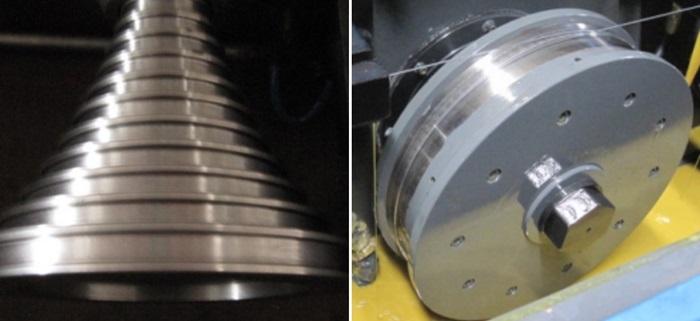
(1) According to capstan geometry, wire drawing machines can be divided into: Tower-type capstan machines, Equal-diameter capstan machines, Conical capstan machines, Double-layer capstan machines.
(2) Tower-type and conical capstans are commonly used in slip-type medium wire drawing machines, while equal-diameter and double-layer capstans are often found in straight-line and large wire drawing equipment.
2.2.4 By Lubrication Method
| Lubrication Method | Working Principle | Characteristics | Application |
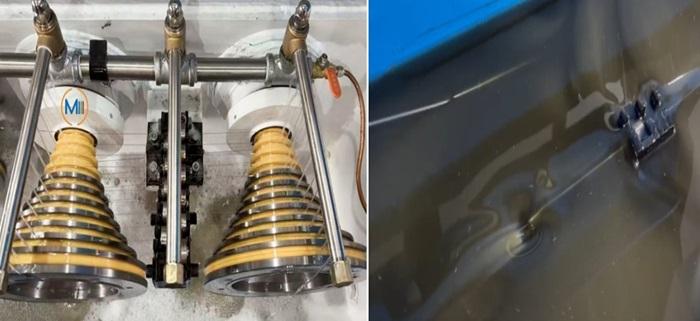
| Spray Lubrication | Lubricant is continuously sprayed onto wires and dies through special pipelines and nozzles. | Suitable for dry or semi-dry drawing processes | Dry and semi-dry wire drawing |
| Immersion Lubrication | The entire drawing area works inside a lubricant bath. | Excellent cooling and lubricating performance | High-speed wet wire drawing |
3.Mechanical Structure and Process Characteristics
3.1 Single-Die Wire Drawing Machines
(1) Single-die wire drawing machines are commonly used for steel wire and other ferrous metal applications.
(2) A typical machine consists of: Pay-off stand, Die holder, Drawing capstan, Drive system.
(3) Depending on the capstan orientation, single-die machines can be divided into horizontal and vertical configurations.
3.1.1 Horizontal Single-Die Machine
(1) In horizontal designs, the capstan is installed horizontally. The capstan serves two functions simultaneously: Providing the drawing force, Acting as a temporary wire storage drum.
(2) Horizontal machines are relatively simple and easy to operate, making them suitable for various heavy-duty drawing applications.
3.1.2 Vertical Single-Die Machine
(1) Vertical single-die machines feature vertically mounted capstans, often with conical designs.
(2) These machines are usually equipped with lifting devices or unloading mechanisms to facilitate coil handling after production.
3.1.3 Single-Die Machines with Take-Up System
(1) To improve surface quality and winding performance, an independent take-up unit is often installed behind the drawing capstan.
(2) This configuration provides more stable wire collection and better finished product quality.
3.1.4 Advantages of Single-Die Machine
(1) Single-die machines offer several benefits:
(2) Simple mechanical structure
(3) Easy manufacturing and maintenance
(4) Flexible process adjustment
(5) Strong drawing capability for large diameters
3.1.5 Disadvantages of Single-Die Machine
(1) Despite their advantages, single-die machines have certain disadvantages:
(2) Large floor space requirements
(3) Low production efficiency
(4) Limited automation
3.1.6 Application of Single-Die Machine
(1) Large-diameter wires
(2) Bars and profiles
(3) High-strength alloy wires
(4) Low-plasticity materials unsuitable for large deformation ratios
3.2 Slip-Type Continuous Multi-Die Wire Drawing Machines
3.2.1 Cylindrical Capstan Machine
(1) Cylindrical capstan machines generally adopt a horizontal arrangement in which all capstans are positioned in a straight line.
(2) This configuration is particularly common in: Large copper wire drawing machine,
large aluminum wire drawing machine, medium wire drawing machine for relatively larger wire sizes
(3) The independent capstan arrangement provides stable operation and high production capacity.
3.2.2 Tower-Type Capstan Machine
(1) In tower-type machines, multiple capstans of different diameters are integrated onto a common shaft, forming a tower-like structure.
(2) This compact design is extensively used in: Medium wire drawing machine, Fine wire drawing machine, high-speed production lines.
(3) Tower-type machines are among the most popular configurations in modern wire manufacturing.
3.2.3 Advantages of Slip-Type Machine
(1) The machine footprint is relatively small, making efficient use of factory space.
(2) Operators can easily replace dies and perform process adjustments.
(3) After machine shutdown, wire diameters at different drawing stages can be measured conveniently.
(4) Modern systems can integrate: Automatic threading, Tension control, Diameter monitoring, Production data collection, Extremely High Productivity.
(5) Continuous multi-die operation enables large-scale industrial production with minimal downtime.
3.2.4 Disadvantages of Slip-Type Machine
(1) The relative sliding between wire and capstan generates considerable friction, resulting in: Higher energy consumption, Increased heat generation, Equipment Wear.
(2) Continuous friction accelerates wear on: Capstan surfaces, Drawing dies.
(3) This increases maintenance requirements and operational costs.
(4) Strict Die Schedule Requirements. The reduction ratio of each die must be carefully designed.
(5) Improper die schedules or capstan wear can lead to: Excessive tension fluctuations, Frequent wire breakage, Reduced production efficiency, Material Limitations.
(6) Slip-type machines are generally unsuitable for materials requiring: Exceptional surface quality, Low tensile stress, Minimal heat generation.
(7) Examples include certain high-performance aluminum conductors and specialized alloy wires.
4.Non-Slip Continuous Multi-Die Wire Drawing Machine
4.1 Accumulator-Type Continuous Wire Drawing Machine
4.1.1 Accumulator-type machines, also known as storage-type wire drawing machines, use wire loops wound around intermediate capstans.
4.1.2 Working Principle: The wire wraps several turns around each capstan before entering the next die.
4.1.3 If minor speed mismatches occur between drawing stages, the stored wire loops act as a buffer, absorbing the differences and maintaining process stability.
4.1.4 Although accumulator systems can compensate for speed variations, they also introduce certain drawbacks.
4.1.5 The wire experiences reverse twisting during operation, which may affect product quality.
4.1.6 Therefore, accumulator-type machines are generally not suitable for: Large-diameter wires, Shaped profiles, High-speed drawing applications.
4.1.7 As a result, their use has become relatively limited in modern high-performance wire production.
4.2 Straight-Line Continuous Wire Drawing Machines
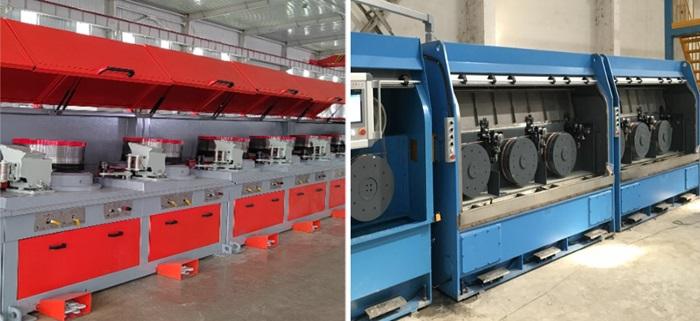
(1) Straight-line wire drawing machines represent the most advanced form of non-slip wire drawing technology.
(2) The wire travels through the machine in a perfectly straight path without any twisting.
(3) Each capstan is equipped with an automatic speed adjustment system, which may include: Tension sensors, Dancer arms, Spring-loaded feedback mechanisms, Electronic control systems.
(4) These devices continuously monitor wire tension and automatically synchronize capstan speed with actual wire speed.
(5) In most cases, each capstan is driven by an independent motor.
(6) No Sliding Friction: Since the wire and capstan move together at identical speeds, friction losses are virtually eliminated.
(7) No Wire Twisting: The straight-line arrangement prevents torsional stress, helping preserve wire quality.
(8) Lower Energy Consumption: The elimination of sliding friction significantly reduces power requirements compared with conventional slip-type machines.
(9) Reduced wear extends the lifespan of: Drawing dies, Capstan surfaces, Transmission components, Superior Product Quality.
The stable tension control and friction-free operation result in: Improved surface finish, Better dimensional consistency, Enhanced mechanical properties.
(10) Straight-line wire drawing machines are particularly suitable for demanding applications involving: High-strength electrical conductors, Hard aluminum wire,
Copper alloy wire, Aluminum alloy wire, Specialty cable materials.
(11) These materials often require strict control of surface quality and mechanical performance, making straight-line machines the preferred solution.
5.Conclusion
Wire Drawing Machine remains the foundation of modern wire and cable manufacturing. From traditional single-die machines to advanced straight-line multi-motor systems, each type of wire drawing equipment serves a unique role within the industry.
Single-die machines continue to provide reliable solutions for large-diameter and specialty materials. Slip-type continuous wire drawing machines dominate high-volume production due to their compact structure and outstanding productivity. Meanwhile, non-slip technologies, especially straight-line wire drawing machines, offer superior energy efficiency, longer tool life, and exceptional product quality for high-performance wire manufacturing.
As industry demands continue to evolve toward higher productivity, lower energy consumption, and better conductor quality, advanced non-slip and independently driven wire drawing systems are expected to play an increasingly important role in the future of wire and cable production.
Click here to see the running video of Wire Drawing Machine
NOTE:All rights reserved, Reprinting is prohibited without permission.