
In modern electrical and telecommunications infrastructure, cable production relies heavily on the performance of stranding machinery. Stranding is the process of twisting multiple metal wires—such as copper, aluminum, or alloys—into a single conductor or cable core. This process improves flexibility, mechanical strength, and electrical performance.
The selection of stranding equipment depends on wire material, cross-sectional size, production capacity, and final application requirements.
This article provides an overview of three main types of stranding equipment: Rigid Frame Stranding Machine, Cradle Stranding Machine, and Cage Stranding Machine.
1.Rigid Frame Stranding Machine
Rigid Frame Stranding Machine is designed for high-speed production of standard conductors. The bobbins are fixed in a rigid rotating structure without back-twist.
1.1 500 vs. 630 Model
1.1.1 500 Model
(1) This model uses 500mm bobbins and is suitable for small to medium production batches.
(2) It processes copper wires from Φ1.5–5.0 mm and aluminum wires from Φ1.8–5.0 mm, with a maximum stranding OD of Φ45 mm.
(3) Its compact structure allows flexible operation and quick changeover, but requires more frequent bobbin replacement.
1.1.2 630 Model
(1) The 630 model uses larger 630mm bobbins and is designed for continuous large-scale production.
(2) It supports copper wire 1.8–4.6 mm and aluminum wire 2.0–5.0 mm, with a maximum stranding OD of Φ35 mm.
(3) It offers longer production runs and higher efficiency, but requires more space and higher investment.
1.2 Drive System Evolution
The evolution of drive systems has significantly improved the performance of the Rigid Frame Stranding Machine.
1.2.1 Shaft Drive System
(1) Traditional Rigid Frame Stranding Machine uses a central shaft to distribute power through mechanical gearboxes.
(2) While synchronization is stable, this structure results in higher energy consumption, noise, and maintenance difficulty.
1.2.2 Multi-Motor Drive System
Modern Rigid Frame Stranding Machine designs adopt independent motors for each rotating unit.
(1) Modern systems replace the shaft with independent motors for each unit.
(2) This improves efficiency, reduces energy loss, and allows flexible control of lay length.
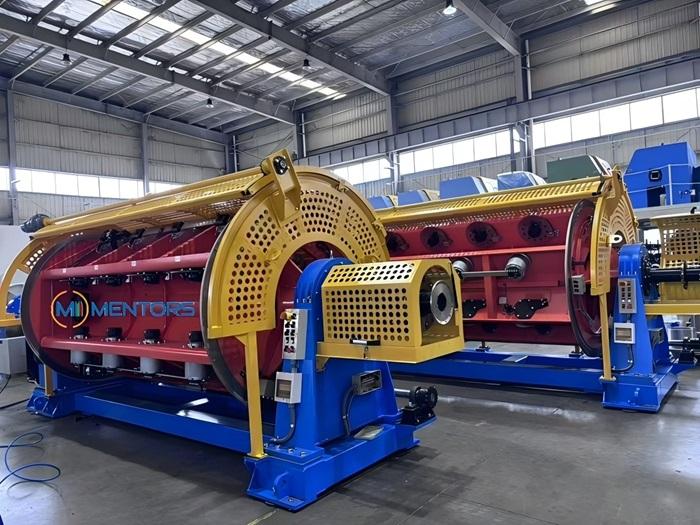
2.Cradle Stranding Machine
The Cradle Stranding Machine is designed for applications requiring high precision and excellent structural consistency, particularly in multi-core power cables.
2.1 Structure and Working Principle
2.1.1 In a Cradle Stranding Machine, the bobbins are mounted inside rotating cradle structures.
2.1.2 These cradles rotate around the central axis while the cable is pulled forward by a traction system.
2.1.3 The key parameter, lay length, is determined by the ratio between rotational speed and linear traction speed. This allows for precise control over the cable structure.
2.2 Key Advantages
2.2.1 The Cradle Stranding Machine offers several important advantages:
(1) High precision: Accurate control of pitch and structure
(2) Excellent roundness: Uniform cable geometry
(3) Stable tension control: Critical for electrical performance
(4) Consistent quality: Suitable for strict industrial standards
Because of these characteristics, the Cradle Stranding Machine is widely used in the production of medium and high-voltage power cables, where performance consistency is essential.
2.3 Typical Applications
2.3.1 Multi-core power cables (4–7 cores)
2.3.2 Insulated conductors
2.3.3 Medium and high voltage cable structures
These applications require precise conductor alignment and uniform tension, which the Cradle Stranding Machine can reliably provide.
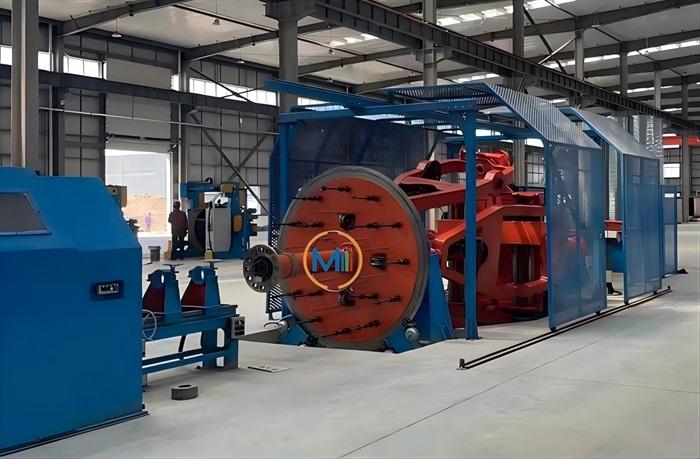
3.Cage Stranding Machine
Cage Stranding Machine is used for more complex cable structures, including control and special cables.
3.1 Application Differences
3.1.1 Cage Stranding Machine handles wire diameters from 1.2–5.0 mm and cable OD from 21–45 mm.
3.1.2 It is commonly used for control cables and multi-layer stranded conductors.
3.1.3 In comparison, Rigid Frame Stranding Machine is mainly used for standard power cables such as copper conductors and ACSR.
3.2 Back-Twist Function
3.2.1 Cage Stranding Machine (with back-twist): The back-twist mechanism eliminates torsional stress during stranding, improving roundness and consistency. However, it limits rotational speed.
3.2.2 Rigid Frame Stranding Machine (without back-twist): Without back-twist, higher production speed can be achieved, making it more suitable for large-scale standard cable production.
3.3 Special Cable Structures
Cage Stranding Machine is suitable for cables requiring fillers, shielding, or complex multi-layer structures, which are not typical in Rigid Frame Stranding Machine systems.
3.4 Additional Capabilities
The Cage Stranding Machine supports advanced cable structures, including:
3.4.1 Fillers inside the cable core
3.4.2 Shielding layers
3.4.3 Multi-layer stranding
These capabilities make it indispensable for customized cable production.
3.5 Comparison with Rigid Frame Machines
| Feature | Cage Stranding Machine | Rigid Frame Stranding Machine |
| Back-twist | Yes | No |
| Speed | Medium | High |
| Structure | Complex | Simple |
| Application | Special cables | Standard conductors |
| Precision | High | Moderate |
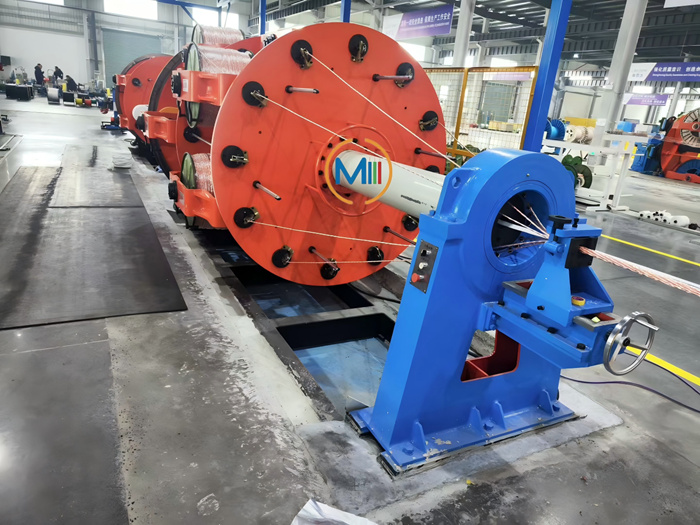
4.Selection Considerations
4.1 Choosing between a Rigid Frame Stranding Machine, Cradle Stranding Machine, and Cage Stranding Machine depends on several factors:
4.1.1 Production volume
4.1.2 Cable type
4.1.3 Precision requirements
4.1.4 Investment budget
4.1.5 Factory space
4.2 For example:
4.2.1 High-volume standard conductors → Rigid Frame Stranding Machine
4.2.2 High-precision power cables → Cradle Stranding Machine
4.2.3 Complex or special cables → Cage Stranding Machine
4.2.4 A proper selection ensures optimal production efficiency and product quality.
5.Conclusion
Modern cable manufacturing relies on advanced stranding technologies to meet increasing performance demands.
(1) The Rigid Frame Stranding Machine delivers unmatched efficiency for large-scale production
(2) The Cradle Stranding Machine ensures precision and structural consistency
(3) The Cage Stranding Machineprovides flexibility for complex cable designs
With continuous advancements in automation, control systems, and energy efficiency, these machines are becoming more intelligent and reliable.
For manufacturers, selecting the right stranding equipment is not just a technical decision—it is a strategic investment that directly impacts product quality, operational efficiency, and long-term competitiveness in the global market.
Click here to see the running video of Rigid Frame Stranding Machine
NOTE:All rights reserved, Reprinting is prohibited without permission.